Make your own natural products

Essential oils for first aid

I was recently approached by a lovely lady to join a local directory of practitioners that can be called upon to serve our community in times of crisis.  She asked me what I would like to appear on the directory and it got me thinking about how I could help and what I can offer. The first thing that came to mind was using essential oils as first aid, as they are what I use by default for so many of life’s unexpected occurrences. And if you’re stuck in the house, can’t get out and/or the supermarket shelves are empty, you might have an essential oil hidden at the back of your cupboard that you can put to good use.

Lavender, the panacea 💜

Of course, my numero uno essential oil for first aid has to be lavender. It is such a useful oil to have in your home and has a myriad of uses. It can be used directly on the skin (check it is a pure essential oil, and if it irritates you then don’t use it) for burns, bites, blisters, cuts and grazes. It is analgesic, vulnery (healing to the skin) and anti-microbial.

For sprains, strains, aches and pains I reach for cornmint essential oil, although peppermint will do the trick too. I prefer cornmint as it has a higher menthol content than peppermint and somehow smells ’cleaner’ (though this is purely personal preference). You can dab a drop of cornmint on your temples if you have a headache, and combine it with a few drops of lavender to rub onto achy muscles and sprained joints. Cornmint is analgesic, anti-spasmodic and cooling.

Eucalyptus is my go to at the first sign of a sniffle. A few drops on a tissue and inhale to help clear the airways, use it in a burner if someone in the office starts sneezing, and/or combine it with cornmint and rub into your feet before bed to help you breathe at night. Eucalyptus is expectorant (helps you cough it up), cleansing and uplifting.

For emotional and mental first aid, frankincense will help get you through. I see it as like a comfy conveyor belt, in that it gently picks you up and carries through (I wish I could think of a better analogy, if you have any suggestions, please let me know!). Dab on a tissue and inhale, add a few drops to your bath and use in a burner. According to Tisserand, frankincense is spiritually uplifting and expansive, it is also mentally rejuvenating, euphoric and gives strength.

I also keep a bottle of rose hydrolat* close at hand to soothe me during stressful times. A splash in a cup of hot water (often drunk when having a bath with added essential oils), gives comfort and solace from the inside out. Rose is nurturing, uplifting and has a balancing effect on hormones, for both men and women.

*Hydrolats, also known as hydrosols, are a by-product of essential oil production. They contain slightly different chemical compounds to the essential oils and share many of their healing properties. It is important to ensure you’re buying true hydrolats as many commercially available products, often sold as ‘rose water’, contain synthetic/artificial ingredients.

Please use your own discernment when using essential oils. If irritation occurs, stop using them.

Uncategorized

Ayurvedic Yoga Massage training

About 10 years ago, I had one of the best massages I’ve ever had. It was called Chavutti Thimeral, and the therapist used her feet to literally walk all over me. Absolute bliss. I’ve been wanting to train in this style of supremely deep pressure (and supremely relaxing) massage ever since.

I was lucky enough to meet the gorgeous Robyn, of AYMChesterfield earlier this year, and she gave me an Ayurvedic Yoga Massage (AYM) that hit all the right deep-pressure spots. From that very first treatment, I knew I just had to learn how to give this massage.

When I enquired about the where in London the Ayurvedic Yoga Massage (AYM) training in the first two weeks of July would be, it was like coming full circle. The venue was in Brixton, which is where I lived when I did my Tisserand Aromatherapy training almost 20 years ago!

A fine view of the city from Brixton, taken from the top deck

It also felt serendipitous because I have a cousin who lives in Tooting, whom I could stay with, and it was only 1 bus ride from his house to the venue (with short walks either end). This is a dream commute for London! Not to mention my cousin and his wife have a beautiful house, they are both great cooks (I definitely put on weight, which is no bad thing!) and couldn’t have been more congenial hosts. I loved every minute with them.

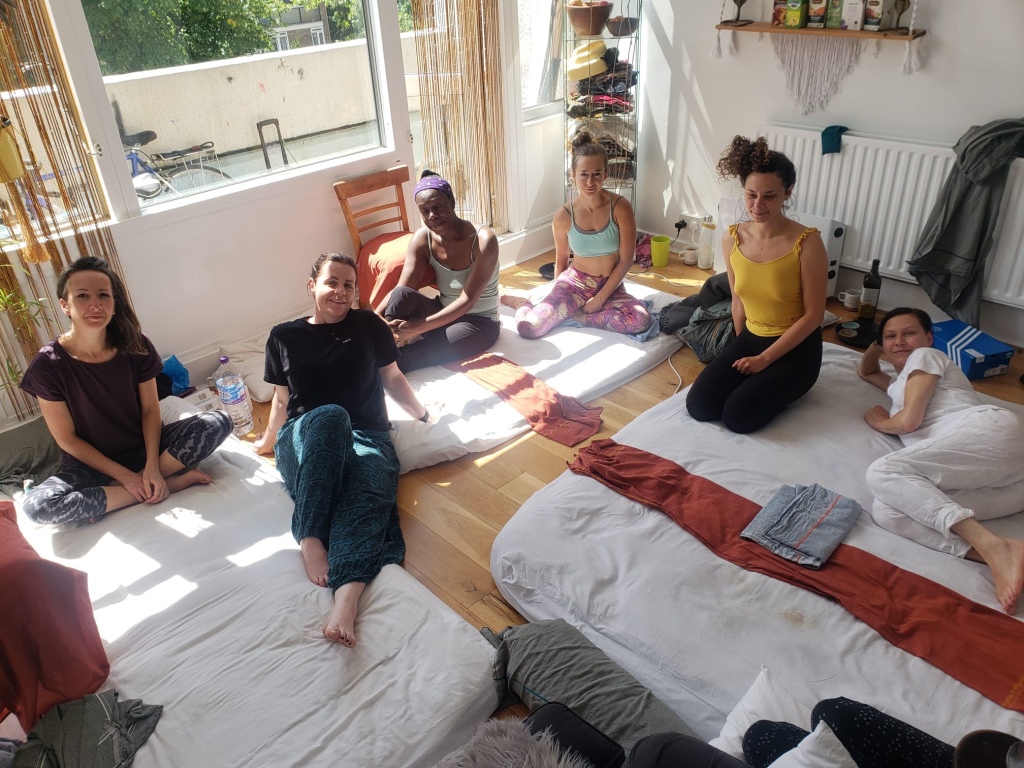
Level one attendees, L-R me, Marie, Vivienne, Charli, Lucy & Joti (pic courtesy Despina Psarra)

The first week of the course was levels one and two, which felt as much of an unlearning for me as it was a learning. From the very first contact of the massage, the pressure is deep and meaningful. I was told off for spreading the oil and then going into the massage. The massage starts the moment you put your hands on and spreading the oil is an integral part of the treatment.

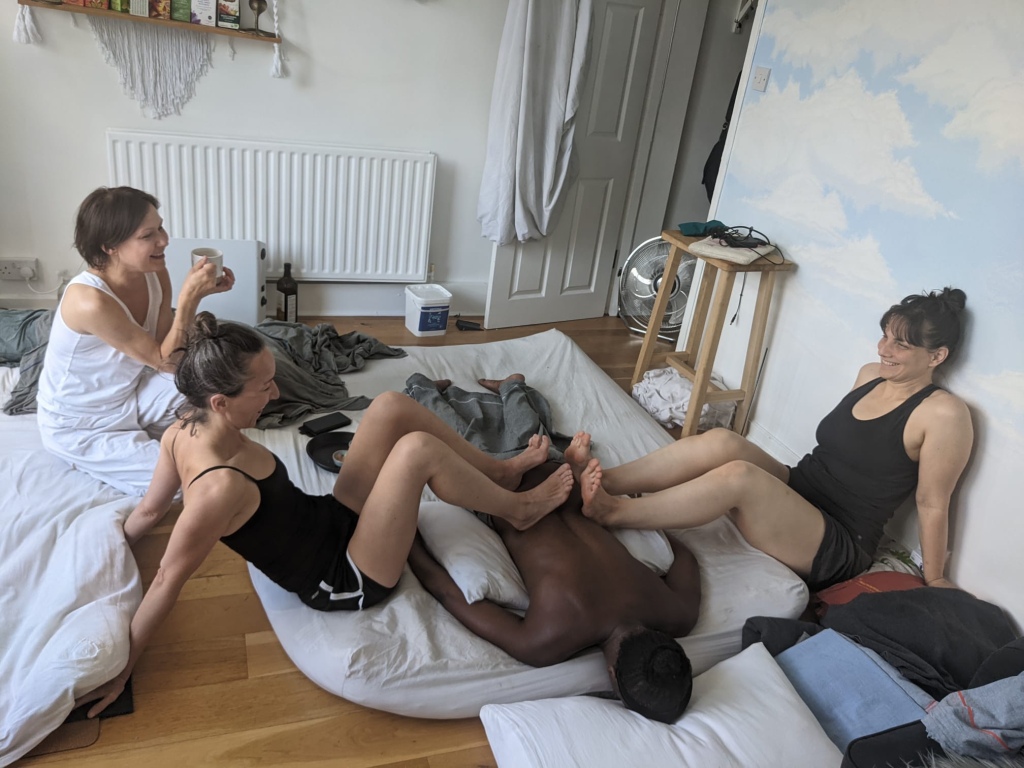
Myself and Despina using our heels for deep relaxation

We also learnt how to use our feet to massage, being careful to support our body weight with a chair or stool, and where to apply the weight so that it releases deep tension and is ultimately relaxing. It was an intense week with lots of techniques to learn, discovering new ways to utilise our bodies for healing.

Stretching out the adductor muscles (photo courtesy Despina Psarra)

The second week (levels three and four) involved learning more techniques such as stretches, tractions and joint decompressions, and putting everything together in a sequence tailored to our individual clients’ needs. AYM is a remedial massage, and we have been taught to think of the skills we’ve learnt as like tools in a tool box, you pick the tools you need to offer the best remedy for your clients.

Fabulous view from the assessment venue

At the end of the second week was our assessment, with a change of venue to Aldgate. A stunning apartment worthy of a magazine cover and the view from the roof garden was unbeatable! The assessment involved a brief consultation with a client and devising a treatment plan. We then proceeded to massage our clients according to the plan, using the techniques we’d learnt under the watchful eye of the course leader, Despina. I’m pleased to say that the three of us that completed the assessment all passed, with much jubilation and relief!

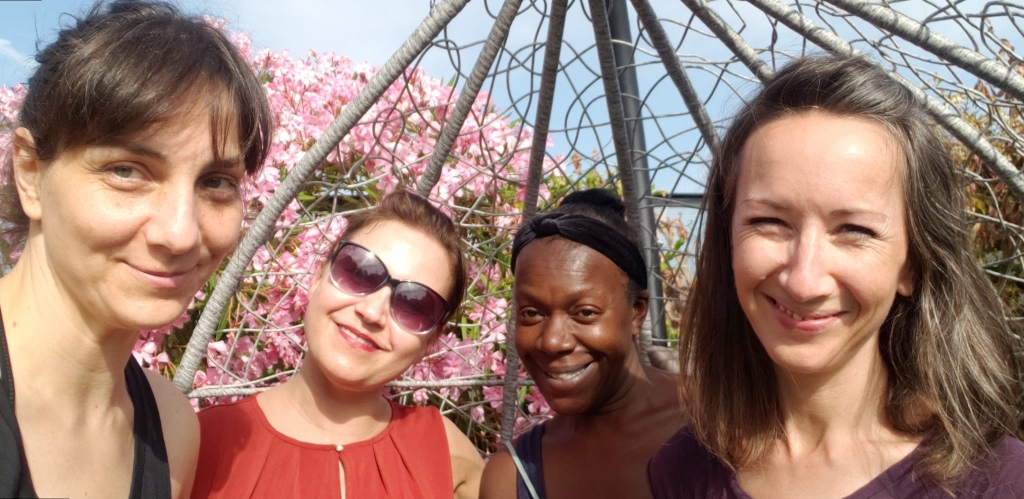
End of assessment smiles! L-R Despina, Joti, Vivienne and myself (photo courtesy Despina Psarra)

I still have a lot to learn, as far as piecing the techniques together (let alone remembering them all!) and until the end of September I’ll be offering half price Ayurvedic Yoga Massage. Each appointment will be 1.5 hours (I will offer 1 hour appointments once I’ve honed my skills) and will be £75 full price. To book your half price session, call or text me on 07980262358 or email Bess@peacewellbeing.co.uk

grief, Uncategorized

Dearest Richard,

December 2012

Last weekend we should have been celebrating your 42nd birthday. We should have been having a garden party, dinner in a fine restaurant or drinks in a wine bar followed by dancing. You would have lit up the dance floor with your enthusiasm, exuberance and energy.

June 2018

We still haven’t celebrated your 40th birthday, flights to Spain and lunch in a Michelin star restaurant cancelled, twice, because of covid. In your head, that means you’re still 39. In my head, you are forever preserved as young, vibrant and joyous. You were born two months before me and now I am older than you. You will not get old. You have been denied that privilege.

Your birthday will be marked with sadness, loss and heartache in perpetuity. At present, I cannot imagine a time when these feelings won’t dominate each anniversary that passes. Each thought I have of you.

And yet I smile too. I smile at the memories of the adventures we had together. Of the mischief we made, of being led astray by you, of the incitement of naughtiness between us. The most fun I’ve had in my life, you were there, leading the charge with your charm, cheek and ginormous heart.

May 2021

You had a tremendous talent for making everyone around you feel included, special and beautiful. The light that emanated from you bounced off everyone you connected with. It was your reflection.

June 2014

The fight to keep your spirit alive is a daily battle. Some days are easier than others. Some days, surrender is the only option. The only way through. Grief is an expression of love. To deny that enunciation, in whatever way it exposes itself, is to deny your existence. This, I have learnt from your beloved Henry. He travels through his grief without repudiation.

December 2017

Henry is building a charitable foundation in your name. He is creating light, from the darkness of your death, and he is preserving, perpetuating and extending your light for the benefit of others. Your light loves on.

Le Petit Singe, the charitable foundation that Henry has set up, raises money to help those affected by sudden bereavement, heart conditions and international environmental and social issues that Richard was involved with. Please visit lepetitsinge.co.uk for more information and to make a donation.

Book Reviews

Book review – The Book You Wish Your Parents Had Read… by Philippa Perry

This beautifully kind, wise and compassionate book has been a wonderful reminder of the parent I aspire to become. It goes without saying, of course, that I am not a perfect parent. Who is? The joy of this book is that it does not set out to achieve perfection (which would only set you up for failure), nor does it reprimand you for mistakes made in the past. It gently encourages you to explore your words, actions and the examples you set to your child, observing how they might affect your child(ren), how they affected you when you were a child and the possible long term effects on your relationship with your child.

It’s not about how many times you mess up, lose your rag and end up crying in a corner (with at least one child screaming on the floor at the same time). It’s about accepting that these things happen, putting actions in to place to minimise them (ie recognising your own limits and how to manage them), and ‘repairing the rupture’ by being compassionate with yourself and authentic in your restorative actions.

It has great examples and case studies of where parents have struggled with their child(ren), even to the point of wanting to leave the family unit, and offers tender, considerate and often humorous responses to the challenges we all face in our parenting (and indeed all) relationships in our lives.

It ties in perfectly with the La Leche League philosophy of ‘loving guidance’, which is one of the many reasons I kept going back to La Leche League. I knew I wanted to follow the gentle parenting path, I think even before I became pregnant, and it was demonstrated so admirably by the mums present at the meetings.

It reminded me that loving guidance is a long term investment (it also has short term benefits too), that patience is a virtue (no one has taught me more about being patient than my son), and that if you’re not looking back at your life and cringing at certain moments, you’re not learning and growing as a person, parent and human being.

Uncategorized

Investigating the effect of reflexology on the breast milk volume of preterm infants’ mothers

A critical review of Mohammadpour A, Valiani M, Sadeghnia A, Talakoub S. Investigating the effect of reflexology on the breast milk volume of preterm infants’ mothers. Iranian J Nursing Midwifery Res 2018;23:371-5.

Mohammadpour et al (2018) conducted a clinical trial on the effects of reflexology on the breast milk volume of mothers of preterm infants. The clinical trial aimed to provide new evidence for the effectiveness of reflexology on breast milk volume and further explore the relationship between lactation and reflexology.  The trial indicates that reflexology is effective in increasing breast milk volume on mothers of preterm infants. However there are several factors that need to be considered when interpreting the results. 

There is no mention in the selection criteria of the mothers of the frequency of breastmilk removal (1) and the effect of preterm delivery on mammogenesis (2) as these are known factors for affecting breast milk volume. As the article itself states, “…the mechanism of milk production is complex, detailed research is required on the relationship between lactation and reflexology”. 

The study shows that statistically, reflexology treatment increased breast milk volume for the first four days of the intervention. It is a low cost intervention with no specialist equipment required but does require a commitment of time from both the mother and the person giving the treatment and training of personnel to administer it. 

The trial contributes to a small but significant group of research on the effects of reflexology on labour, delivery and lactation (11) (12) (5).  It adds to the body of knowledge in this emerging field of reflexology research and shows us how much more there is to discover when there is enough data to generate systematic reviews and meta-analysis. Only then can conclusive arguments be made. 

The points stimulated during the treatment given were those generally accepted to affect the areas of the breasts (between the metacarpals of the toes) and the pituitary gland reflex (on the pad of the big toe).  The pituitary reflex point is included as the point at which the oxytocin hormone originates (9), Oxytocin causes the ‘let down’ reflex of the milk, pushing milk out of the breast when the breast is stimulated by suckling from a baby or the suction of a breast pump. 

All the mothers who participated in the trial had delivered their baby via Caesarian section, which is known to delay the onset of lactogenesis II (10). This puts all the mothers on a level playing field, as mixed delivery methods can not be compared. It is unfortunate that the trial couldn’t have been completed exclusively on mothers who had delivered vaginally, as this is the norm.  As the article states “…the impossibility of selecting participants who had had a natural delivery was another limitation of this study”. 

I question the ethics of separating the mothers into just the two groups of intervention and control. Would the psychological effects of participating in a study but not knowingly getting the intervention (ie foot massage) have an effect on lactation?  Could it be the time taken to receive the intervention, allowing the mothers to sit and relax at an undoubtedly stressful period of their lives have more of an effect than the reflexology itself? We already know that reflexology has been shown to reduce levels of anxiety (3)(4) by reducing stress hormone (adrenaline and noradrenaline) levels and increasing endorphins and oxytocin (5), which has a direct effect on lactation (6). Might it have been a better methodology to separate them into a reflexology group, a general foot massage group and a control group? This may then definitively prove that it is the specific reflex points that are responsible for the increase in breast milk volume. It is unclear what the researchers are trying to prove with their methodology. 

The frequency of milk removal from the breast is one of the greatest contributing factors to output volume (7), and timing of early breast milk expression too (8). These factors were not apparent in the selection of the mothers for the trial and their non-compliance in the researcher’s request to not use other interventions to increase milk supply can not be ruled out. Prolactin, the hormone responsible for breast milk production, increases throughout pregnancy, and premature deliveries between 22 to 34 weeks gestation may cause mammogenesis to be incomplete for full lactation (2). Again, this has not been taken into account in this study and will have an impact on the milk volume output, and as the mothers selected are between 29 – 36 weeks gestation, conclusions are hard to draw. 

It is a very small scale study and although the statistics drawn from it clearly show there is an increase in breast milk volume in the reflexology intervention group, there are too few participants to say with complete confidence that reflexology has an effect. Further trials must be undertaken, with more precise selection criteria and larger samples to improve our understanding of the reflex points and their effect on breast milk volume. This is an emerging field and this trial shows how much more we have to learn about reflexology and it’s potential benefits.  It has shown some interesting and exciting insights into the relationship between reflexology and breast milk volume and I look forward to more research being carried out and published. The stronger the evidence base, the stronger the arguments will be to include reflexology treatment in the care of mothers and their infants during pregnancy, child birth, breastfeeding and beyond. 

References 

(1) Infant demand and milk supply. Part 1: Infant demand and milk production in lactating women.

Daly SEHartmann PE. 1995.

(2) Complicating influences upon the initiation of lactation following premature birth Cregan, M. D. et al (2007).

(3)Effect of foot reflexology on anxiety of patients undergoing coronary angiography Mahmoudirad et al 2013

(4)The Effect of Foot Reflexology on Anxiety, Pain, and Outcomes

of the Labor in Primigravida Women. Hanjani et al 2013

(5) A concept analysis: the effect of reflexology on homeostasis to establish and maintain lactation. Tipping et al 2000

(6) The Womanly Art of Breastfeeding, La Leche League International, 8th edition, Pinter & Martin. 

(7) Breastfeeding and Human Lactation, Riordan & Wambach, 4th edition, Jones & Bartlett

(8) Effect of early breast milk expression on milk volume and timing of lactogenesis stage II among mothers of very low birth weight infants: a pilot study.

Parker LA1, Sullivan SKrueger CKelechi TMueller M.

(9) Reflexology in Pregnancy and Childbirth, Tiran, 1st edition, Churchill Livingston. 

(10) Risk factors for suboptimal infant breastfeeding behavior, delayed onset of lactation, and excess neonatal weight loss. Dewey KG1, Nommsen-Rivers LAHeinig MJCohen RJ. 2003.

(11) The Effect of Reflexology on Pain Intensity and Duration of Labor on Primiparas.  Dolatian et 2011

(12) Reviewing the effect of reflexology on the pain and certain features and outcomes of the labor on the primiparous women Mahboubeh et al, 2010