Book Reviews, midwifery

Book Review: Reclaiming Childbirth as a Rite of Passage, by Rachel Reed

I don’t think I’ve ever put so my sticky markers in a book! This is packed full of gems of information that take you on a journey through normal physiological birth, informing the reader of the rites of passage of childbirth and how these rites have been perverted over the centuries.
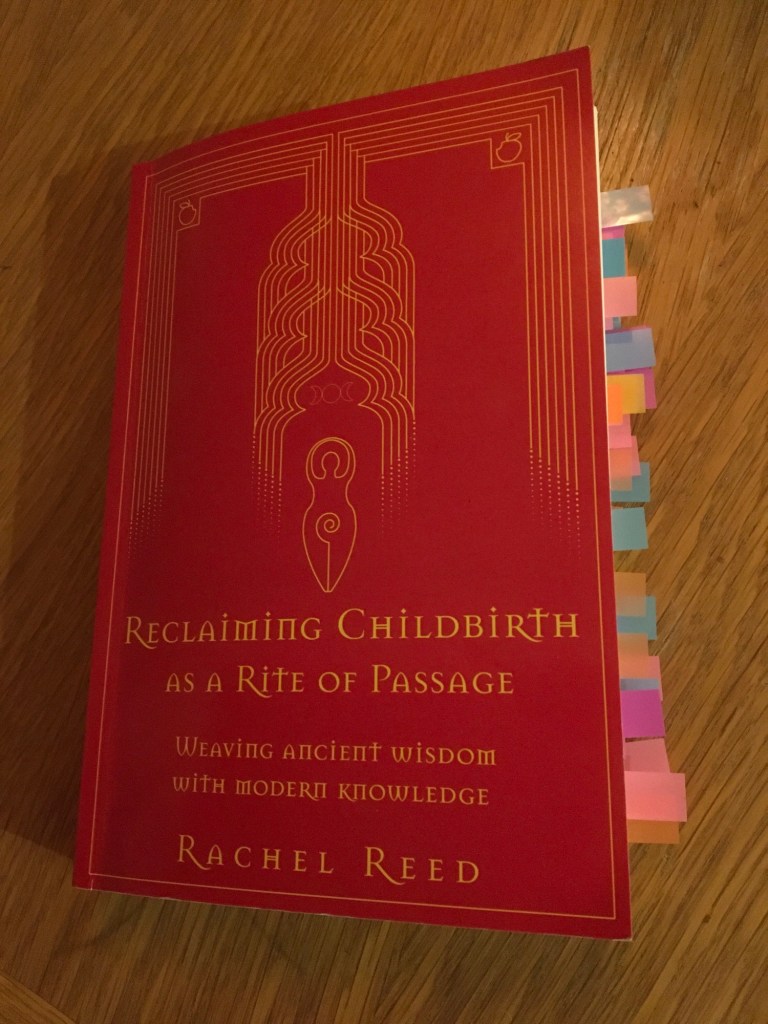
So many sticky notes!

I love how Rachel quite literally weaves the story of a labouring Eve through the text and adds herstory, giving context to the birthing process within the current medicalised system.

From my personal experience, and that of my sisters and close friends, the journey to becoming a mother is the most profound and life altering process embarked upon. The rites of passage involved are myriad and highly individual, but are all too easily derailed by the rites of protection undertaken by institutions to keep the control with the care givers and prevent litigation for when things go wrong.

This book underpins those rites of passage and provides evidence (or lack there of), for the interventions offered during childbirth. It is incredibly well researched and equips pregnant women with all the information required to make decisions based on true, fully informed consent. This book also provides tools for health professionals to empower the women in their care to navigate their transition into motherhood with support, understanding and promotion of rites of passage.

I now need to go back through my sticky markers to colour coordinate them into subjects such as postpartum haemorrhage, breastfeeding etc, as this will help me revise what I’ve learned and serve as an excellent reference tool for my studies. I think this is a book that all pregnant women, midwives, maternity workers, obstetricians and other health professionals involved in their care should read.

Women who are denied their rites of passage are denied their power, often without any awareness that it is happening. This book seeks to restore the balance of power and place it firmly in the hands (and hearts) of pregnant women, by equipping themselves and their caregivers with the evidence to support their passage to motherhood.

midwifery

I’m now a student midwife!

And still enjoying seeing clients for aromatherapy, Indian head massage, reflexology and Ayurvedic yoga massages.

I started the course last month (September 2023) and am due to graduate in summer 2026. So far so good, although it is, inevitably, affecting my availability to see clients. However, I still love giving massage and have no plans to stop for the foreseeable future.

The course is divided into theory blocks of 6-8 weeks, and work-placement blocks of 6-8 weeks. During theory blocks, I’ll be attending university in the week, so I can take appointments for evenings and weekends, plus usually one week day per week.

On work-placement blocks, I will either be working 3/4 shifts per week in a hospital (and therefore will have 3/4 days a week available for appointments) or in the community, which will be Monday to Friday, 8am – 4pm, so will have evenings and weekends free.

I know that there will be times when appointments have to be moved, and I apologise in advance for any inconvenience caused. I will always give as much notice as possible and I appreciate your understanding in this.

The skills I will gain as a midwife, combined with the skills I already possess as a massage therapist, will enhance and deepen my offering to you, my clients. I see the midwifery degree as an extension of my current practice and can’t wait to combine both sides of my work.

Give me a call and I’ll get you booked in for a relaxing massage asap.

Make your own natural products

Essential oils for first aid

I was recently approached by a lovely lady to join a local directory of practitioners that can be called upon to serve our community in times of crisis.  She asked me what I would like to appear on the directory and it got me thinking about how I could help and what I can offer. The first thing that came to mind was using essential oils as first aid, as they are what I use by default for so many of life’s unexpected occurrences. And if you’re stuck in the house, can’t get out and/or the supermarket shelves are empty, you might have an essential oil hidden at the back of your cupboard that you can put to good use.

Lavender, the panacea 💜

Of course, my numero uno essential oil for first aid has to be lavender. It is such a useful oil to have in your home and has a myriad of uses. It can be used directly on the skin (check it is a pure essential oil, and if it irritates you then don’t use it) for burns, bites, blisters, cuts and grazes. It is analgesic, vulnery (healing to the skin) and anti-microbial.

For sprains, strains, aches and pains I reach for cornmint essential oil, although peppermint will do the trick too. I prefer cornmint as it has a higher menthol content than peppermint and somehow smells ’cleaner’ (though this is purely personal preference). You can dab a drop of cornmint on your temples if you have a headache, and combine it with a few drops of lavender to rub onto achy muscles and sprained joints. Cornmint is analgesic, anti-spasmodic and cooling.

Eucalyptus is my go to at the first sign of a sniffle. A few drops on a tissue and inhale to help clear the airways, use it in a burner if someone in the office starts sneezing, and/or combine it with cornmint and rub into your feet before bed to help you breathe at night. Eucalyptus is expectorant (helps you cough it up), cleansing and uplifting.

For emotional and mental first aid, frankincense will help get you through. I see it as like a comfy conveyor belt, in that it gently picks you up and carries through (I wish I could think of a better analogy, if you have any suggestions, please let me know!). Dab on a tissue and inhale, add a few drops to your bath and use in a burner. According to Tisserand, frankincense is spiritually uplifting and expansive, it is also mentally rejuvenating, euphoric and gives strength.

I also keep a bottle of rose hydrolat* close at hand to soothe me during stressful times. A splash in a cup of hot water (often drunk when having a bath with added essential oils), gives comfort and solace from the inside out. Rose is nurturing, uplifting and has a balancing effect on hormones, for both men and women.

*Hydrolats, also known as hydrosols, are a by-product of essential oil production. They contain slightly different chemical compounds to the essential oils and share many of their healing properties. It is important to ensure you’re buying true hydrolats as many commercially available products, often sold as ‘rose water’, contain synthetic/artificial ingredients.

Please use your own discernment when using essential oils. If irritation occurs, stop using them.

Uncategorized

Ayurvedic Yoga Massage training

About 10 years ago, I had one of the best massages I’ve ever had. It was called Chavutti Thimeral, and the therapist used her feet to literally walk all over me. Absolute bliss. I’ve been wanting to train in this style of supremely deep pressure (and supremely relaxing) massage ever since.

I was lucky enough to meet the gorgeous Robyn, of AYMChesterfield earlier this year, and she gave me an Ayurvedic Yoga Massage (AYM) that hit all the right deep-pressure spots. From that very first treatment, I knew I just had to learn how to give this massage.

When I enquired about the where in London the Ayurvedic Yoga Massage (AYM) training in the first two weeks of July would be, it was like coming full circle. The venue was in Brixton, which is where I lived when I did my Tisserand Aromatherapy training almost 20 years ago!

A fine view of the city from Brixton, taken from the top deck

It also felt serendipitous because I have a cousin who lives in Tooting, whom I could stay with, and it was only 1 bus ride from his house to the venue (with short walks either end). This is a dream commute for London! Not to mention my cousin and his wife have a beautiful house, they are both great cooks (I definitely put on weight, which is no bad thing!) and couldn’t have been more congenial hosts. I loved every minute with them.

Level one attendees, L-R me, Marie, Vivienne, Charli, Lucy & Joti (pic courtesy Despina Psarra)

The first week of the course was levels one and two, which felt as much of an unlearning for me as it was a learning. From the very first contact of the massage, the pressure is deep and meaningful. I was told off for spreading the oil and then going into the massage. The massage starts the moment you put your hands on and spreading the oil is an integral part of the treatment.

Myself and Despina using our heels for deep relaxation

We also learnt how to use our feet to massage, being careful to support our body weight with a chair or stool, and where to apply the weight so that it releases deep tension and is ultimately relaxing. It was an intense week with lots of techniques to learn, discovering new ways to utilise our bodies for healing.

Stretching out the adductor muscles (photo courtesy Despina Psarra)

The second week (levels three and four) involved learning more techniques such as stretches, tractions and joint decompressions, and putting everything together in a sequence tailored to our individual clients’ needs. AYM is a remedial massage, and we have been taught to think of the skills we’ve learnt as like tools in a tool box, you pick the tools you need to offer the best remedy for your clients.

Fabulous view from the assessment venue

At the end of the second week was our assessment, with a change of venue to Aldgate. A stunning apartment worthy of a magazine cover and the view from the roof garden was unbeatable! The assessment involved a brief consultation with a client and devising a treatment plan. We then proceeded to massage our clients according to the plan, using the techniques we’d learnt under the watchful eye of the course leader, Despina. I’m pleased to say that the three of us that completed the assessment all passed, with much jubilation and relief!

End of assessment smiles! L-R Despina, Joti, Vivienne and myself (photo courtesy Despina Psarra)

I still have a lot to learn, as far as piecing the techniques together (let alone remembering them all!) and until the end of September I’ll be offering half price Ayurvedic Yoga Massage. Each appointment will be 1.5 hours (I will offer 1 hour appointments once I’ve honed my skills) and will be £75 full price. To book your half price session, call or text me on 07980262358 or email Bess@peacewellbeing.co.uk

Make your own natural products, Uncategorized

How to make your own deodorant using kitchen cupboard ingredients

Hello there sovereigns, today I’m going to show you how to make your own deodorant using things that you can find in your kitchen. Plus essential oils of course.

The equipment and ingredients you need are

DIY deodorant with essential oils
Everything you need
  • a freshly boiled kettle
  • a larger bowl
  • a smaller bowl
  • measuring spoons
  • tea spoon
  • small jar (mini jam jar is fine)
  • coconut oil
  • bicarbonate of soda
  • essential oils

Method

Add a teaspoon of coconut oil to the small bowl. Pour a puddle of freshly boiled water into the larger bowl. Place the small bowl inside the larger bowl, but don’t let the water come over the top of the small bowl. Stir the coconut oil until it’s melted, it will only take a few minutes.

Once the coconut oil is melted, take the small bowl out of the larger bowl and add a level tablespoon of bicarbonate of soda to the melted coconut oil. Stir together to form a thick paste.

Add 15 drops in total of essential oil to the paste. You could use 15 drops of one oil, 7 drops each of two different oils, or 5 drops each of three different essential oils. Choose ones that you like and that don’t irritate your skin. You can make your blend of essential oils for your deodorant as unique as you are!

Now pour this into your jar and leave to cool until solid. You can put it in the fridge to speed up the cooling process if you like. Store and use the deodorant at room temperature.

To use, scrape a smidge with the back of your fingernail, rub between fingertips and then rub into your armpits. Done! Totally natural, very cheap and quick to make and an effective, yummy smelling deodorant.