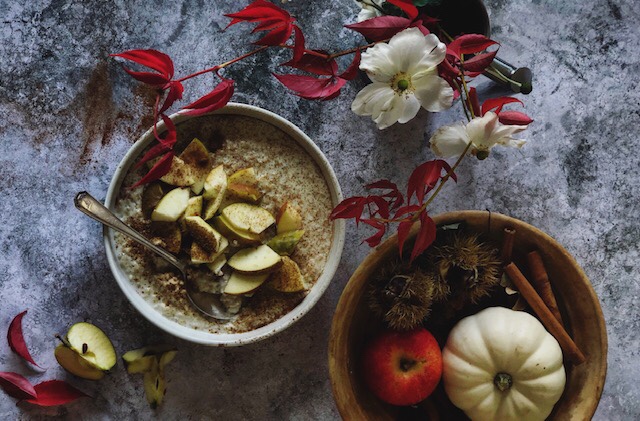
The nights are drawing in, the mornings are getting darker and the car windscreen needs clearing before it’s safe to drive. All these things make me think about it being cold outside but cosy inside, and one of my favourite dishes to have for breakfast to get me warmed up in the morning is porridge.
Image courtesy of Black Velvet Styling
This recipe happens to be vegan, not that I am vegan (or even vegetarian) but I’m not a massive fan of milk (love cream, cheese and butter though!). You wouldn’t know it’s dairy-free because to me it tastes like lemon cheesecake, I think it’s the oats thickening as they cook that gives it a creamy consistency. It also uses two of my favourite seasonal ingredients – apple and cinnamon.
I hope you enjoy it, let me know how you get on and what your favourite way of eating porridge is.
Lemon Cheesecake* Porridge
Makes 2 generous bowls
1 cup oats
2 cups water
Juice of 1 lemon
1 apple, cored & grated
1 tbsp maple syrup
Ground cinnamon, to serve
Soak oats, water and lemon juice in saucepan overnight – optional but optimal.
Add the grated apple and maple syrup to the pan.
Cook over a medium heat, stirring constantly, until bubbling, thick and creamy.
Divide between two bowls and serve with a sprinkle of ground cinnamon.
*As mentioned above, this recipe is dairy-free, there’s no cheese in it, it just tastes like lemon cheesecake to me.
My first guest blog from my dear friend Barbara Goodall. She’s an aromatherapist, gardener and foodie so I couldn’t think of anyone better to write about growing and eating your own lavender. Head on over to http://www.timeout-for-you.co.uk/ for more about what she does.
Lavenders thrive in full sun and well drained soil… Mine loved the conditions this summer!!
Grow your own…
Two species of lavender are growing in my garden, giving a long flowering period for my pleasure as well as providing nectar for many butterflies, bees and other insects.
True Lavenders such as Lavandula angustifolia ‘’Hidcote’ (height c. 30cm x spread c. 30cm) provide a high quality essential oil. This compact plant has blue/green narrow leaves and intense, dark blue flower spikes from late spring to early summer. I also love the effect and simplicity of the vertical stems before the flowers open!
Hybrids such as Lavandula x intermedia ‘Grosso’ (Ht 90cm x sp 90cm) are slightly less hardy, have long, loose spikes and flowers a month later..
By cutting back my lavenders after flowering, just above the woody stems, I leave some green tips that will have at least a month’s growth to protect the plant from the frost. In the spring, after the frosts I give them a wee trim back to keep them neat and compact.
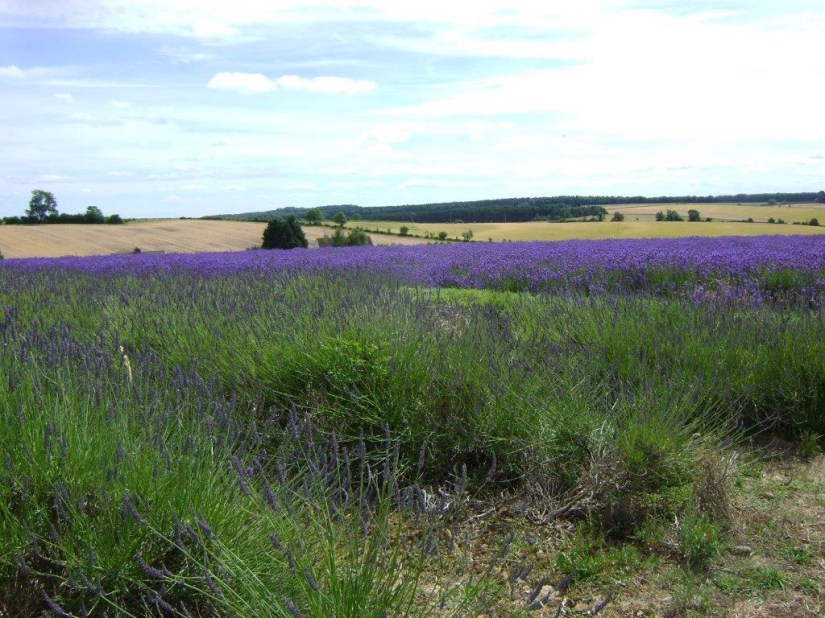
Lavender Field in Wiltshire
In Cooking…
Adding fresh lavender to my shortbread and scone recipes is a gentle way to enjoy the therapeutic effects of the essential oil and is a reminder of warm sunny days…
I grind a few chopped lavender flowers (maybe half a teaspoon), in a pestle and mortar for a floral taste and smell, or finely chop the leaves for a more balsamic earthy flavour. See below for the recipe.
So many therapeutic qualities to choose from…
Julia Lawless gives some wonderful descriptions in her book Lavender Oil, Nature’s Soothing Remedy.
An excellent essential oil for skin care, a valuable soothing remedy and a good analgesic, its regulating effect on the nervous system is unique.
Its nature is balancing and harmonising and is neither yin nor yang in the extreme and tends to increase the overall effectiveness of a remedy when used in combination with it.
Lavender is a supreme adaptogen. It can have a restorative effect in cases of listlessness or weakness, yet has a calming effect on those prone to hyperactivity or agitation.
Lavender Shortbread recipe
190C/Gas mark 5/6 for 10 to 15 minutes
Makes c.24
Ingredients:
200g butter
100g icing sugar sieved
200g plain flour
100g cornflour
Pinch of salt
½ to 1 tsp finely chopped lavender flowers
Caster sugar for sprinkling
Method:
Chop butter and soften
Beat in icing sugar
Add flour, salt and lavender little by little kneading well to form a smooth dry paste, initially with a flat bladed knife and then with your lightly floured fingers
Turn onto a floured worktop and roll into a sausage shape, say 5cm in diameter
If you are patient, wrap in greaseproof paper and chill in the fridge for an hour
Slice into discs and place onto baking trays and sprinkle with caster sugar
Bake in the oven for 10 minutes or so depending how golden brown you like your biscuits.
Leave on your baking tray for 5 minutes before you transfer them to a cooling tray


 Peacewellbeing.co.uk